Thursday, August 20, 2015
Budapest Flooding
On Monday evening Budapest received over three inches of rain in one hour. The results are characterized in online news articles as apocalyptic and
tsunami-like. Those Budapest scenes look a lot like Tucson at this time of year in most years, although not so much so far this year. Hopefully in Budapest they've recovered in time for Hungary's national holiday today. Coincidentally, today is also Tucson's 240th birthday.

Monday, August 3, 2015
Upcoming El Niño Seasons
Here in Tucson the rain for the past week finally met expectations. But already, even before the monsoon begins to wane, attention is turning to the upcoming El Niño seasons. It will be interesting to see if the consensus outlooks hold for a strong El Niño to develop and persist through the winter. Whatever the strength of El Niño may turn out to be, the evolution of the weather patterns will be fascinating.
I was preparing to update a five-year-old plot and accompanying rant concerning winter precipitation variability here in Tucson, which I had made back when a La Niña was on the way. But a few days ago the local paper had a tantalizing story discussing the prospect of an active tail-end to the monsoon this year, because El Niño.
So I decided to see what the actual numbers look like. Traditionally September rains would be considered the tail-end of the monsoon, and a tropical system in early October would be beyond the monsoon. Actually, that's still the official definition. Instead of trying to separate the two, I totaled the precipitation for the two months of September and October. The precipitation data are from the Western Regional Climate Center. I used the latest, official definition of the calculation of the Oceanic Niño Index by the Climate Prediction Center. There are a total of 65 years on the plot. Selected specific years are labeled.

I hope that nobody tries to fit a straight line through the plotted points. If this year's October ONI is greater than +1.0, as present trends and most projections suggest, what does history tell us about what to expect? On the plot, there are eight years with an October ONI greater than +1.0 (the right one-third of the plot). For seven of those eight years, the combined total September-October precipitation was at least 1.7 inches. In contrast, the left two-thirds of the plot contains 57 years with an October ONI less than +1.0. Of those 57 years, nearly half had less than 1.7 inches, and two of those years had no measurable rain in either month. So this year, bet on more than 1.7 inches in September-October, because you will have a very good chance of not losing that bet. But another way to summarize the right side of the plot would be to say that in six out of those eight years, precipitation was within plus or minus one half inch of the 65-year mean, which is 2.21 inches. On the other hand, one might choose to go with a persistence forecast, imagining that whatever factors contributed to last year's, i.e. 2014, September-October precipitation performance, those factors are only better this year, and thus the decade of the 2010's might join the 1970's as star contributors toward the upper right quadrant of the plot.
Citing 1972's disastrous tropical system Joanne as the
I was preparing to update a five-year-old plot and accompanying rant concerning winter precipitation variability here in Tucson, which I had made back when a La Niña was on the way. But a few days ago the local paper had a tantalizing story discussing the prospect of an active tail-end to the monsoon this year, because El Niño.
So I decided to see what the actual numbers look like. Traditionally September rains would be considered the tail-end of the monsoon, and a tropical system in early October would be beyond the monsoon. Actually, that's still the official definition. Instead of trying to separate the two, I totaled the precipitation for the two months of September and October. The precipitation data are from the Western Regional Climate Center. I used the latest, official definition of the calculation of the Oceanic Niño Index by the Climate Prediction Center. There are a total of 65 years on the plot. Selected specific years are labeled.

I hope that nobody tries to fit a straight line through the plotted points. If this year's October ONI is greater than +1.0, as present trends and most projections suggest, what does history tell us about what to expect? On the plot, there are eight years with an October ONI greater than +1.0 (the right one-third of the plot). For seven of those eight years, the combined total September-October precipitation was at least 1.7 inches. In contrast, the left two-thirds of the plot contains 57 years with an October ONI less than +1.0. Of those 57 years, nearly half had less than 1.7 inches, and two of those years had no measurable rain in either month. So this year, bet on more than 1.7 inches in September-October, because you will have a very good chance of not losing that bet. But another way to summarize the right side of the plot would be to say that in six out of those eight years, precipitation was within plus or minus one half inch of the 65-year mean, which is 2.21 inches. On the other hand, one might choose to go with a persistence forecast, imagining that whatever factors contributed to last year's, i.e. 2014, September-October precipitation performance, those factors are only better this year, and thus the decade of the 2010's might join the 1970's as star contributors toward the upper right quadrant of the plot.
Citing 1972's disastrous tropical system Joanne as the
kind of thingthat could happen this year would at least be the right analogy--both years with oncoming strong El Niños. Citing 1983's September-October disastrous sequence of events as an example of what can happen in an El Niño year, while discussing this year's high and rising ONI's, is mixing apples and oranges. The 1983 data point would support imagining a big September-October next year. That data point is the only big year making the argument for a lagging effect in September-October from the previous winter's El Niño. But then 1972 is the only data point arguing for a big September-October this year. Certainly the possibility of disastrous flooding triggered by tropical systems in September and early October is a concern, but it should be a concern most years. Dangling the notion that that concern should be higher in Tucson this year because a strong El Niño is developing is not supported by the data.
Saturday, March 21, 2015
Hungary
Tuesday was about all things Irish. But now back to Hungary. The posts at Hungarian Spectrum, along with other English-language sites recommended there, provide comprehensive, detailed and, sadly I believe, accurate analyses of the political situation in Hungary.
If I ever do manage to visit Hungary on a March 15th--their independence day--I would hope to spend part of the day in a particular village in the northeast corner of Hungary. When I drove to Tarpa last summer, a very nice family there patiently listened to my poor efforts at speaking Hungarian, and they repeated slowly over and over until I at least partially understood. I didn't think to write down their names, and I have no idea which political chants they might endorse. But I keep thinking about the town square in Tarpa. I like the memorials there better than the ones closest to the parliament building in Budapest. With Tarpa's Rákóczi, both horse and rider have a calm, alert, dignified, maybe stoical pose. Behind them, on the corner of the town hall, are the names of Tarpa's leaders in the 1956 revolution. Given the event that took place in a Budapest cemetery a little over a month ago, it's nice to know that Tarpa has a wreath honoring the Hungarian side in 1956.

If I ever do manage to visit Hungary on a March 15th--their independence day--I would hope to spend part of the day in a particular village in the northeast corner of Hungary. When I drove to Tarpa last summer, a very nice family there patiently listened to my poor efforts at speaking Hungarian, and they repeated slowly over and over until I at least partially understood. I didn't think to write down their names, and I have no idea which political chants they might endorse. But I keep thinking about the town square in Tarpa. I like the memorials there better than the ones closest to the parliament building in Budapest. With Tarpa's Rákóczi, both horse and rider have a calm, alert, dignified, maybe stoical pose. Behind them, on the corner of the town hall, are the names of Tarpa's leaders in the 1956 revolution. Given the event that took place in a Budapest cemetery a little over a month ago, it's nice to know that Tarpa has a wreath honoring the Hungarian side in 1956.

Tuesday, January 27, 2015
Don't Blame The Models
I happened to notice this news story (only excerpts below) appearing at a variety of online sites this morning (1/27/15).
But yesterday's storm was not even a case of all models having converged on a solution. I remembered seeing the word
Don't blame the models. Blame policies, procedures, sloppy communications and training.
MOUNT HOLLY, N.J. (AP) — A National Weather Service official says the agency will evaluate its storm modeling after a storm that was predicted to dump a foot or more of snow on many parts of New Jersey and the Philadelphia region delivered far less than that. ... ... says the storm tracked a bit to the east of what forecasting models predicted. ... ... says the agency will evaluate what happened to see how it can do better in the future.I am a big opponent of the phrase
confidence is high because models have converged on a solution.Red alarm bells should go off any time a forecaster starts to use that phrase. Confidence should be high because alternatives have been ruled out, not because a certain number of models have converged on a small subset of the universe of still plausible scenarios.
But yesterday's storm was not even a case of all models having converged on a solution. I remembered seeing the word
outlierin yesterday's forecast discussions. This morning I searched for that word in the Mount Holly discussions, but discovered that
outlierhad been last used by that office on Sunday afternoon. Instead it was in two of yesterday's discussions for New York, NY, where that word appeared.
New York, NY 10:05 AM [Monday] NWP GUIDANCE HAS SHOWN A LITTLE MORE SPREAD THAN ONE WOULD LIKE TO SEE AT SUCH A SHORT RANGE. MUCH OF THE 00Z GUIDANCE LOWERED QPF AMOUNTS FOR MUCH OF THE REGION...WHICH WOULD MEAN LOWER SNOW TOTALS. HOWEVER... ... DID NOT WANT TO MAKE DRASTIC CHANGES TO THE EXPECTED SNOW AMOUNTS AND HEADLINES WITH JUST ONE MODEL CYCLE. IN FACT... ... THE 00Z GFS APPEARS TO BE A FAST NE OUTLIER.(The omitted sections in the above quote, after
howeverand
in fact, are where the forecaster's confidence was being elevated by model output.)
New York, NY 1:34 PM [Monday] THE STORM APPEARS ON TRACK. THE 12Z GFS IS AN OUTLIER FROM THE 12Z NAM AND 12Z ECMWF. HAVE UPPED SNOWFALL TOTALS ACCORDINGLY WITH MOST AREAS IN THE 20-30 RANGE FOR THIS EVENT.Nobody wants to hear a forecaster be wishy-washy. People want to hear your best shot. At the same time it is possible to communicate what could go wrong. But instead of acknowledging plausible alternatives, the messages to the public (e.g., upgrading watches to warnings 18 hours before the start of the event) were indicating that forecaster confidence was exceeding record highs.
Don't blame the models. Blame policies, procedures, sloppy communications and training.
Friday, September 26, 2014
Hungarian Scientist Sites
This continues reporting on my pilgrimage to sites associated with famed Hungarian/Hungarian-American scientists. Last year's visit is covered in the Budapest Gymnasiums post. At the end of last year's post was my intent to visit the site of the former Minta Gymnasium. Today it is an elementary school, the Trefort School of the ELTE University. Founded as a high school (gymnasium) by Theodore von Karman's father, the school emphasized hands-on, students-discovering-things-for-themselves learning. Edward Teller, who was 20-some years younger than Theodore von Karman, was also a student at the Minta Gymnasium.

The school is on a very short street, Trefort utca. In fact the school building occcupies about half the length of the street. It was cloudy with light rain the day I walked by. But it was also warm, and so the windows were open. There was a constant buzz of activity from inside, so I guess the hands-on learning technique still applies.
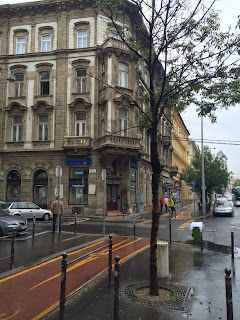 The building on the left, on the Báthori utca corner of Bajcsy-Zsilinszky út, is where John von Neumann (Neumann János) was born and where he lived until he was eighteen. There are plaques on both sides of the display window. The plaque on the left side (in line with the man standing in front of the stop sign) was installed jointly by the American Mathematical Society and its Hungarian counterpart on the 100th anniversary of the birth of Neumann János, in 2003. The top half of the plaque is in Hungarian, repeated in English on the bottom half. The plaque on the right, Hungarian only, explains that it was originally installed in 1987 and then reinstalled in 2004 by the Hungarian Computer Science Society, recognizing his pioneering work in that field also.

The school is on a very short street, Trefort utca. In fact the school building occcupies about half the length of the street. It was cloudy with light rain the day I walked by. But it was also warm, and so the windows were open. There was a constant buzz of activity from inside, so I guess the hands-on learning technique still applies.

Monday, June 16, 2014
Reforecasts
Ensemble reforecasts (Hamill et el., 2013) are available at the NOAA ESRL site. The site also provides real-time forecast data and real-time products, the latter having been calibrated based on the historical performance of the reforecasts. Among their list of products is an option to generate plots for a user-selected point displaying time series of the ensemble forecast spread of precipitation and temperature. The precipitation time series for my favorite point (32N, 111W; Tucson) have been consistent over the past week or so. Out of eleven members of the ensemble only one or two have been generating small amounts for tomorrow, roughly in agreement with the latest short-term model guidance of 10% POP (slightly higher chance of thunder) for tomorrow and Wednesday. The ensemble spread product is currently showing the next chance of small amounts of precipitation starting around 28 June.
Off and on I have been exploring how well the reforecasts handle fluctuations in precipitable water (PW) in and around Arizona, focusing on a month-long period centered around [the traditional Tucson understanding of] the start of the monsoon. I have been using the model initial conditions as verification. The data displayed in the figure below are from the initial conditions for the grid cell (T254 = 0.47 degrees lat/lon) closest to Tucson.

The figure contains three horizontal dashed lines for reference. Besides the line highlighting one inch of PW, the other two lines are labeled with approximate late-afternoon surface dewpoints (with a typically dry mid-level cap). There are 29 years of initialized data (and reforecasts, not shown), 1985 through 2013. Of those 29 years, 7 of the years on the indicated day were drier than the 25th percentile, 3 of the years were more moist than the 90th [corr. 1 Jul, original 16 Jun read 10th] percentile, etc. There are some interesting things to notice about the analyzed distribution during this month-long period. At the beginning of the period, on 20 June, only about 10 percent of the years have PW over one inch, while by the end of the period, on 20 July, about 75 percent of the years have PW over one inch. Also, it would be a mistake to look at only the upward trend in the mean, without noticing that the spread of the distribution reaches a maximum around the 4th of July. This large spread results in part from the fact that the dry percentiles (brown) level off for about one week, from 28 June until 5 July. The leveling off in turn is a composite from: (1) a few years that become moist in late June, and stay that way into July; (2) a few years that stay dry into early July; and (3) most years, 18 out of 29, which have a double peak--moistening in late June, then more or less drying out for an extended period in early July. A particularly high-amplitude version of this double peak was in the year 2004, when PW peaked at over one inch on 24 June (putting that year in the top ten percent for 24 June). Then the year 2004 dipped to less than 15 cm from 29 June through 7 July. Anyway, the point about the upcoming transitional period is that the ensemble reforecasts have a difficult challenge to meet in representing climatology, let alone for the forecast in a particular year to convey a sense of which days may depart from climatology.
Monday, June 9, 2014
Duplicitous shill?
Today that label was applied to Chris Matthews, in a The Huffington Post post by Joseph A. Palermo entitled
Smearing Private Bergdahl: the Republican Right Descends to a New Low.Over the weekend I also read in the Pittsburgh Post-Gazette a column by Tony Norman entitled
Bergdahl case unleashes all the hypocrites.Since I agree somewhat with both, but not entirely with either of those analyses, here is my impression. Bergdahl was a first-termer with a healthy sense of compassion for and interest in the people of Afghanistan, along with an unhealthy lack of fear (and perhaps disrespect for orders). The enemy took advantage of his curiosity to capture him. Eventually we will hear from Bergdahl himself. But at this point I don't know why anyone wants to read into it any more than that. Although I've often been disappointed with Obama's performance, I'm proud of the President's decision to make and his execution of the exchange. I am as proud of President Obama, as I am ashamed of Chris Matthews' (not to mention my barber's) smearing of a captured, now released, soldier.
Subscribe to:
Posts (Atom)